Free cheat sheets

Finance on a page

The ideas finance professionals use, boiled down to a few pages you can read in two minutes. Read the latest sheet below, then get the printable pack and a new guide every week by email.

Get the printable pack
Latest sheet

DCF Cheat Sheet

How to tell if anything is worth its price today, on four pages: the idea, the four-step recipe, a loan paid back two ways, and solar panels that only pay off if you keep them long enough.
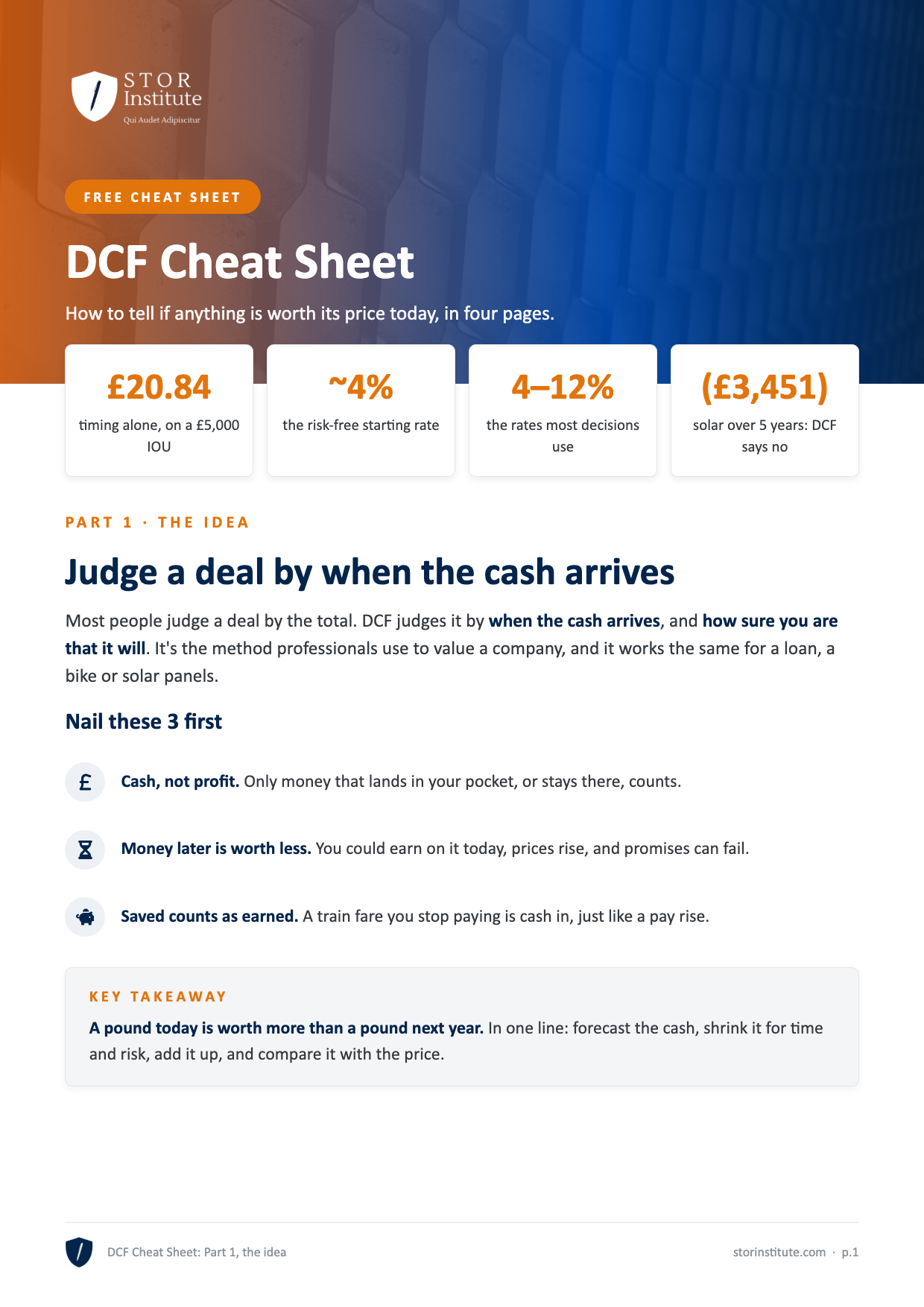
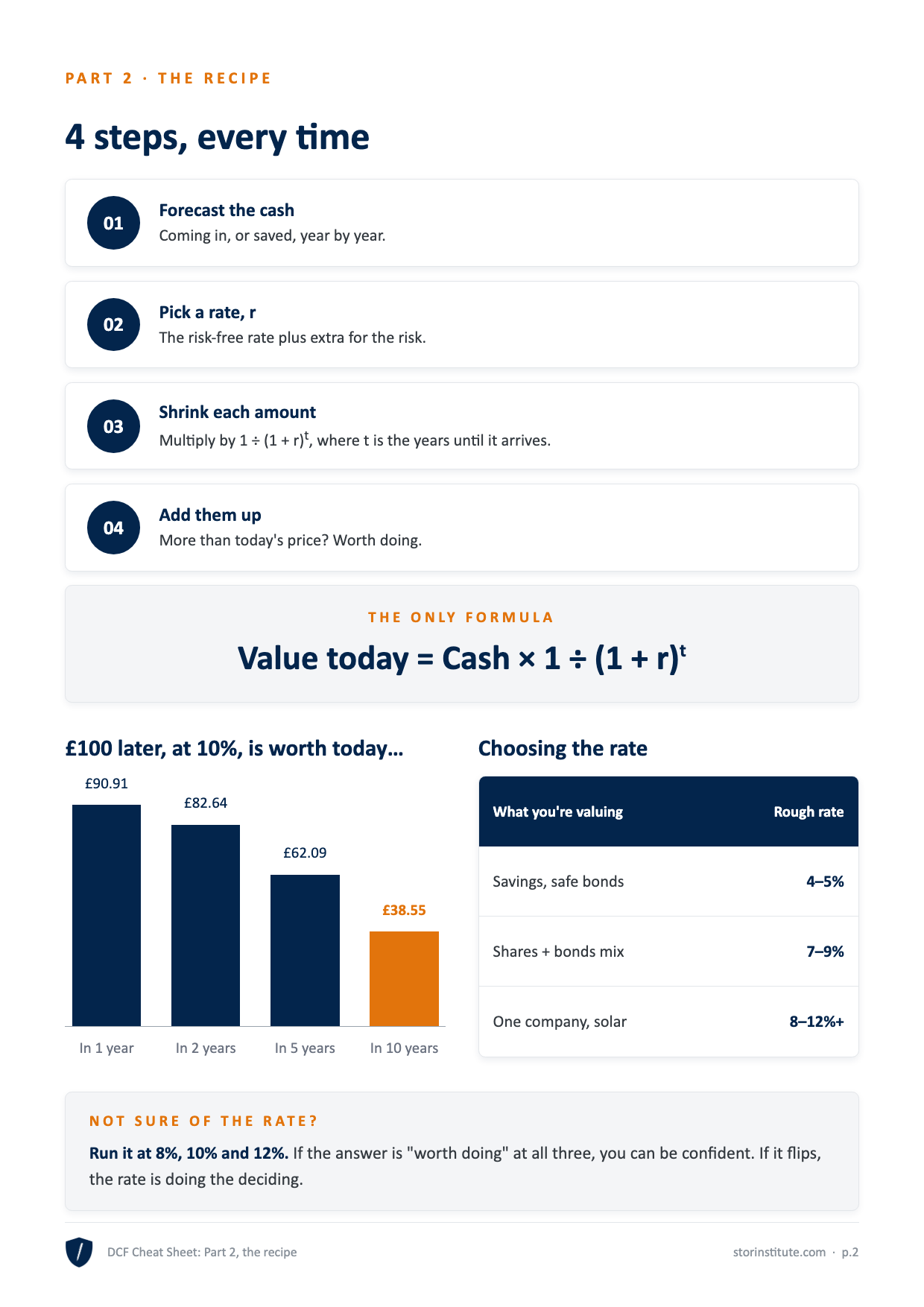
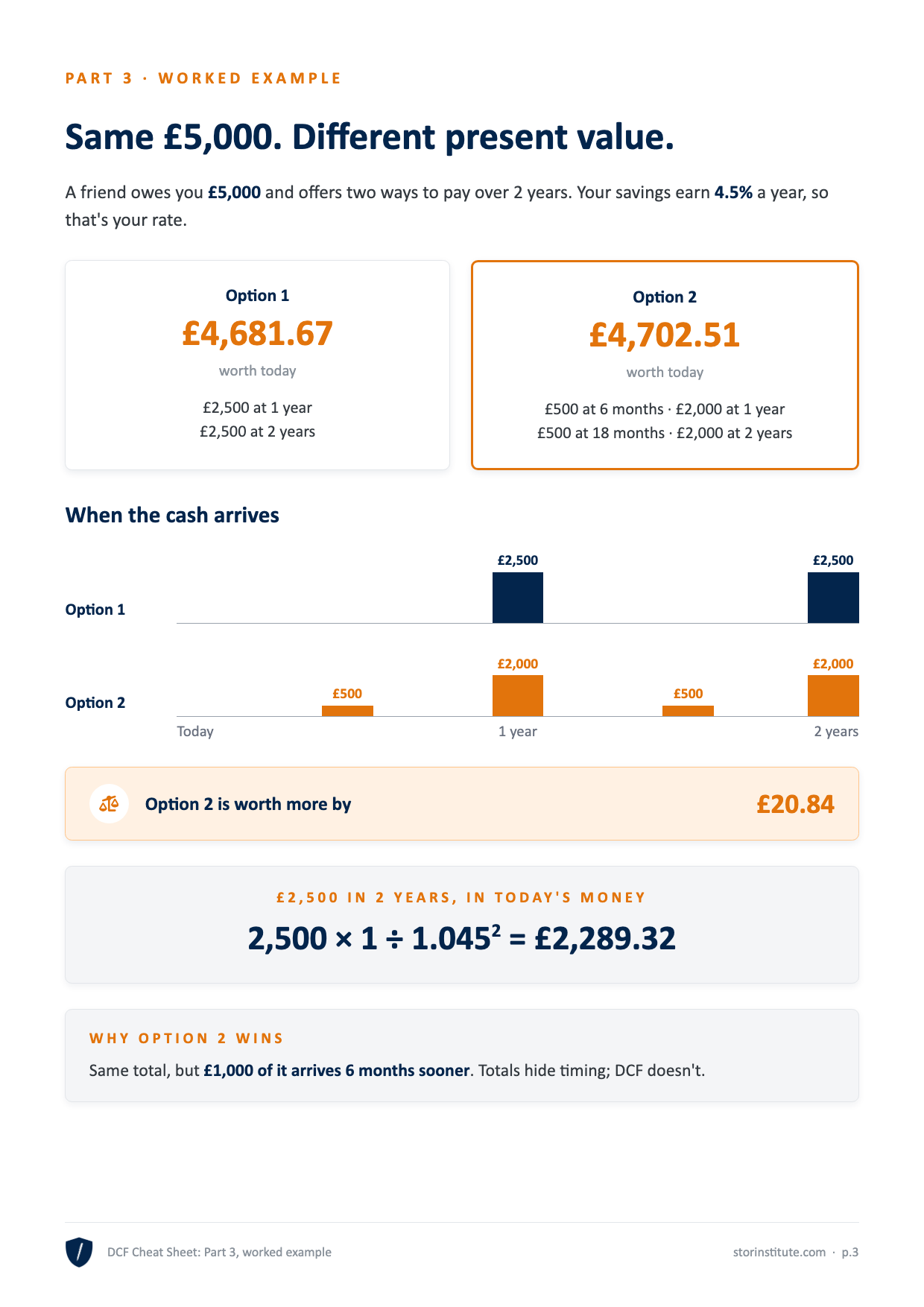
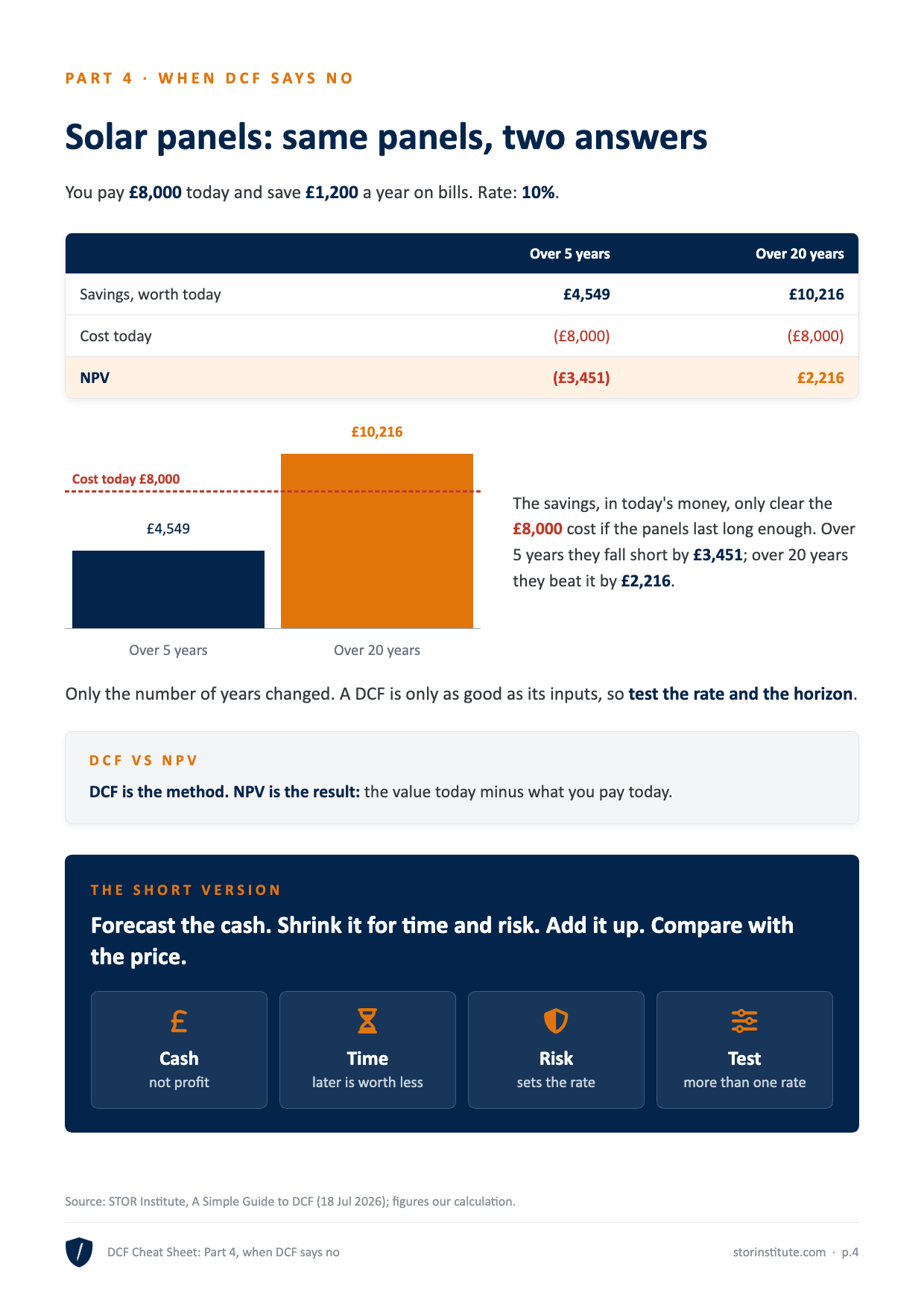
DCF Cheat Sheet, page 1 of 4: the idea. How to tell if anything is worth its price today, in four pages. Four numbers: £20.84, timing alone, on a £5,000 IOU; about 4%, the risk-free starting rate; 4–12%, the rates most decisions use; minus £3,451, solar over 5 years: DCF says no. Judge a deal by when the cash arrives: most people judge a deal by the total; DCF judges it by when the cash arrives and how sure you are that it will. It's the method professionals use to value a company, and it works the same for a loan, a bike or solar panels. Nail these 3 first: cash, not profit; money later is worth less; saved counts as earned. Key takeaway: a pound today is worth more than a pound next year. In one line: forecast the cash, shrink it for time and risk, add it up, and compare it with the price.DCF Cheat Sheet, page 2 of 4: the recipe. 4 steps, every time: forecast the cash, coming in or saved, year by year; pick a rate, r, the risk-free rate plus extra for the risk; shrink each amount by multiplying by 1 ÷ (1 + r) to the power t, where t is the years until it arrives; add them up, and if the total is more than today's price it's worth doing. The only formula: value today = cash × 1 ÷ (1 + r)^t. £100 later at 10% is worth £90.91 in 1 year, £82.64 in 2, £62.09 in 5 and £38.55 in 10. Choosing the rate: savings and safe bonds 4–5%; shares and bonds mix 7–9%; one company or solar 8–12% or more. Not sure of the rate? Run it at 8%, 10% and 12%. If the answer is worth doing at all three, you can be confident; if it flips, the rate is doing the deciding.DCF Cheat Sheet, page 3 of 4: worked example. Same £5,000, different present value. A friend owes you £5,000 and offers two ways to pay over 2 years; your savings earn 4.5% a year, so that's your rate. Option 1, £2,500 at 1 year and £2,500 at 2 years, is worth £4,681.67 today. Option 2, £500 at 6 months, £2,000 at 1 year, £500 at 18 months and £2,000 at 2 years, is worth £4,702.51 today. Option 2 is worth more by £20.84. £2,500 in 2 years in today's money: 2,500 × 1 ÷ 1.045 squared = £2,289.32. Why option 2 wins: same total, but £1,000 of it arrives 6 months sooner. Totals hide timing; DCF doesn't.DCF Cheat Sheet, page 4 of 4: when DCF says no. Solar panels: same panels, two answers. You pay £8,000 today and save £1,200 a year on bills, at a 10% rate. Over 5 years the savings are worth £4,549 today, so the NPV is minus £3,451; over 20 years they are worth £10,216, so the NPV is £2,216. Only the number of years changed: a DCF is only as good as its inputs, so test the rate and the horizon. DCF vs NPV: DCF is the method; NPV is the result, the value today minus what you pay today. The short version: forecast the cash, shrink it for time and risk, add it up, compare with the price. Cash, not profit; time, later is worth less; risk sets the rate; test more than one rate.
Page 1 of 4

Swipe or use the arrows. Tap a page to open it full screen.

Read the full guide to DCF

Get the printable pack + a new guide every week

  • This sheet as a print-ready PDF, straight to your inbox
  • A new finance guide every week, plus new cheat sheets as they come out
  • No account or password. Just your email

We only use your email for these emails. See our privacy policy.